


.png)
Role
Game Designer
Team Size
14
Length Of Development
18th August 2025 - 5th October 2025
Genre
Platformer
Software
UE5, GitHub, Trello, Miro, Word, Excel, Teams
Walkthrough
Project Overview
Walking the King is a 2.5D platformer where the player must carry and balance an egg on their head while navigating different obstacles and traps. The main objective is to make it to the end without losing all their lives - which is done by dropping the egg. It draws inspiration from Human Fall Flat and Getting Over It.
As the sole gameplay designer alongside a UI/UX designer, I was responsible for shaping the core gameplay experience while collaborating across departments. The internship provided an opportunity to gain first-hand experience working in a professional development pipeline and adapting to the challenges of remote teamwork.
Key Contributions


-
I created an initial game design overview and basic game loop for the concept of a pitched balancing game.
-
The intention was to quickly establish the scope for the game - the length of the internship combined with everyone working their own hours and the complexity of the game made a clear vision for the game an urgent priority.
Design Considerations


-
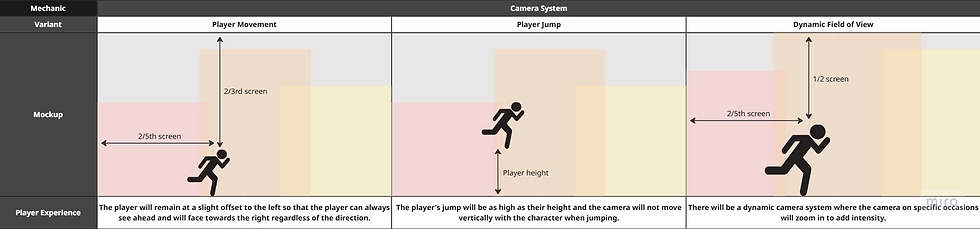
These diagrams were all made within Miro which was useful for improving team collaboration and visibility and also for showing the inspiration behind my diagrams - Death Stranding for the balancing mechanic is an example.
-
Some features were either altered over time or scrapped due to a combination of feedback and changes in the direction of the game.
Camera, Character & Controls


-
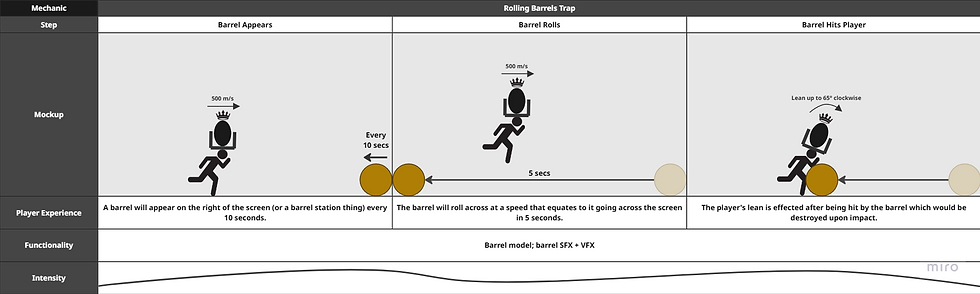
These traps were designed to be repeatable, placeable all over the level and combinable with each other.
-
They were intended to challenge the main mechanic - balancing - and force the player to have to constantly watch their speed and tilt, thus making balance meaningful.
Trap Diagrams


-
I helped the technical designers with implementing the wind and barrel traps into Unreal - the leaning elements of the wind trap and the overall functionality of the barrel trap.
-
My main role was mostly polishing the feel of them and ensuring they correctly interact with the player character, therefore increasing the quality of the player experience.
Trap Implementation


-
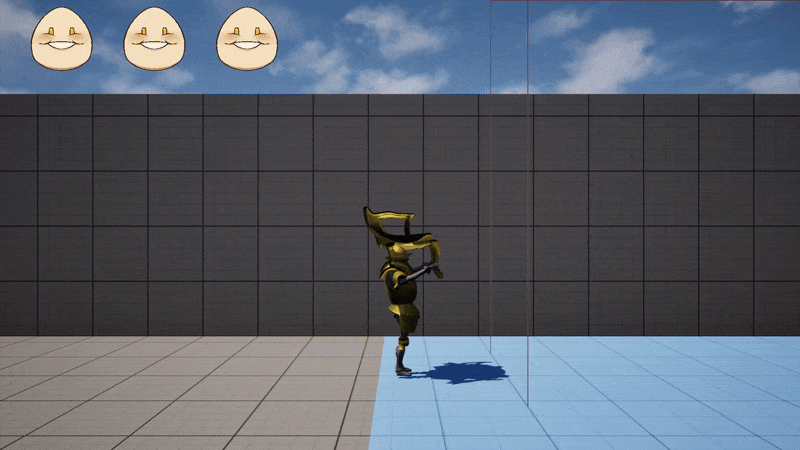
I implemented balance triggers inspired by Death Stranding to help adjust lean when attempting to move at certain points.
-
I also did the final version of the animation blueprint - this was heavily simplify compared to its initial iterations and also enabled the wind trap effect.
Character Implementation
Post-Mortem
What went well?
-
I gained valuable experience in a professional remote environment, collaborating effectively across multiple disciplines.
-
I adapted to the challenge of being the only gameplay designer, taking initiative in creative decision-making and producing high-quality design work.
-
I effectively communicated, showcasing my growth in collaboration, problem-solving and game design thinking.
What did not go well?
-
The remote environment created challenges in maintaining consistent communication and a constant workflow.
-
The game pitch that was decided on was not one I was enthusiastic to work on, which was at times difficult to navigate as the only gameplay designer.
-
The project scope was overly ambitious for the limited timeframe, reducing the final product’s level of polish and therefore the extent to which the player experience goals were met.
What did I learn?
-
The importance of structured communication and collaborative planning in remote development environments.
-
The ability to adapt professionally and creatively, even when working on a project outside my comfort zone.
-
How simplifying scope and focusing on core mechanics can lead to a more polished and achievable outcome.